OSM talk at London Wiki Wednesdays

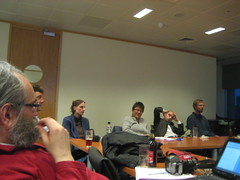
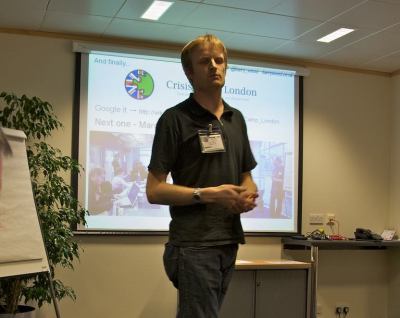
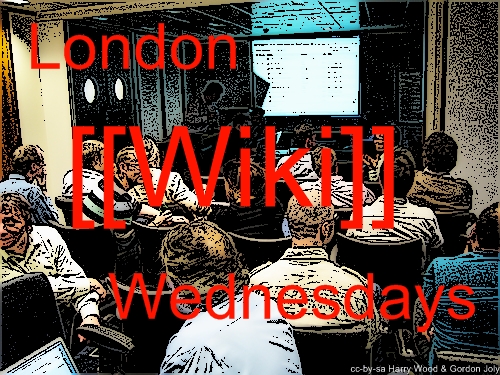
London Wiki Wednesdays last night (Wednesday night in fact) was pretty good. It was kindly hosted by NYK line in the amazing city point tower. Here’s the slides for the little talk I gave:

‘OpenStreetMap : The Wikipedia of Maps’ on slideshare

In fact on the second slide you can see the city point tower in the aerial imagery screenshot.

My talk was explaining the similarities between this large open mapping collaboration, and wikipedia. Although mainly it was just a very quick run through of OpenStreetMap.  ( Some links related to the slides: the Flash editor, the desktop app editor, API, mapping techniques, gordo’s photo, stats, the Open License, opencyclemap.org, openpistemap.org, Hiking Map, Whitewater Maps, bus map, CloudMade style editor, and a zoomed in map of the building  )

David Terrar is back in the wiki mood and managing to secure venues and sponsors for future months, so I think it’s looking good. It will be somewhere different in November. Check back on the London page for details

London Wiki Wednesdays are back tonight

London Wiki Wednesdays

There was a series of monthly London Wiki Wednesdays events with presentations and networking chit-chat, all about wikis, blogs and social media technology, mostly as applied to enterprise use. Sadly they stopped happening back in 2008    ….but tonight they’re back!

London Wiki Wednesdays 7th October 2009

When I first went to Wiki Wednesdays a couple of years ago, I was massively enthusiastic about wiki collaboration in open content communities such as wikipedia, entirely for fun, as a hobby (though mostly pursued while bored at work). The events really opened my eyes to the possibility of working in this arena. I wanted a piece of this action. At the same time I was getting hooked on OpenStreetMap. Wiki-style collaboration to build a free map of the world. Since the last Wiki Wednesdays meet-up I’ve ditched my more dull I.T. job and got myself a job working full time on OpenStreetMap, so this evening I’m returning victorious!

I’m going to give a talk about OpenStreetMap. The talks are only 5 mins, so hopefully they’ll be a bunch of other talks. Often these are about behind-the-firewall or b2b collaboration style uses. Should be good.

The Shaftesbury Re-opened

Hallelujahpraisethelord my local pub has re-opened!

….Change the openstreetmap node back to amenity=pub

….Update the details on deadpubsociety wiki.

….Tell everyone about it on stroudgreen.org (*1)

….Leave a message on their myspace page (*2)

The Shaftesbury is back!

(*1 Hmmm no actually theyre way ahead of me)
(*2 Nooo! My eyes! MY EYES! )

Wiki Wednesdays - 1st October

Last night’s London Wiki Wednesday was held at the BCS offices, and a load of BCS folk came along. They’re a funny old bunch, and judging by their comments, they found the wiki wednesday people rather odd too.

I explained one detail of using wikipedia to somebody who had been experimenting with editing there. Basically I had to show him the finer points of picking through a wiki history display to figure out what had happened to his contribution. I guess this isn’t the easiest thing for a newbie to grasp. Interesting to follow through useability problems from a newbie’s point of view. I wonder if there’s scope for interface innovation to make that easier.

Someone had reverted his contribution, and explained why in their editing comment. Perhaps the thing which really went wrong here, was that the explanation was very brief and therefore unclear (the newbie didn’t even register that this was the explanation) Wikipedia these days is full of people who will revert edits in a somewhat cavalier manner, and this is surely putting off a lot of potential new contributors. On the flip-side though, wikipedia articles need to withstand a bombardment of sub-standard edits somehow. I guess “defenders” of wikipedia need to try hard to engage people with useful explanations about how to improve their contributions. Basically we should always assume good faith, but when faced with people pushing biased viewpoints or promotional links, engaging in conversation can be the last thing you want. Not an easy balance to strike, but I do think a lot of wikipedians are too harsh and disdainful with their reverting these days.

But wikis are not just about wikipedia! Wiki Wednesday discussion came around to MediaWiki several times (a pleasant change from the usual “enterprise” slant) This was despite starting out with a discussion on the evils of Microsoft Sharepoint, which I don’t really have much experience of (thankfully!)

It was good to meet Dario Taraborelli. If I was doing a PHD, I’d want it to be on topic like his. Interesting stuff! He showed us some of his work on wikitracer and analysis based on spidering to gather wiki metrics across many different wiki websites.

Dario Taraborelli

This is something I’ve experimented with myself. More than two years ago now, I was practising my skills with ‘TIBCO BusinessWorks’, and created a web-scraping bot to generate a list of wikis by response time to help with early building of the database at wikiindex.org. Bots are fun! That reminds me. I need to fire up my more recent java creation again some time. The “most active london wikipedians” bot.

Wiki Wednesdays - Back in 2008

Last week the London Wiki Wednesdays thing kicked off again, which I’m pleased about. I enjoyed this regular meet-up of wiki and web 2.0 enthusiasts. It was happening monthly for a while, but this is the first time we’ve managed to get together in 2008. Apparently David Terrar has been struggling to find people to host it, so if anyone knows anyone who has a big (~40 capacity) room with a projector, we’d love to use it (in exchange for appreciative blog links). Big thanks to David Terrar for managing to bring it together again, and special thanks this time since he paid for the food & drinks himself! I showed my appreciation by drinking all the booze and rambling to him on the tube on the way home! And thanks to Alek for hosting us again.

OmCollab logoAndreas Rindler’s OmCollab looked interesting. It’s a blending of MediaWiki with Wordpress and bookmarking tools. Some nice customisations, obviously including skinning, but also dropping in various extensions for added toolbar buttons, category tag clouds, easy attachments etc.

Andy Roberts pointed out that wordpress is adding a ‘revisions’ feature, which is rather wiki-like. This kicked off a discussion about using wordpress as a wiki , whether it can be regarded as a wiki, and whether you want to use it that way. Without actually playing with it, it’s not clear whether it would support open editing, how it would relate with the “publish” button, or what would appear in RSS feeds. Personally I don’t expect wordpress to become a wiki. It is fundamentally a blogging tool, and this little revision feature does not represent a dramatic departure from that. But it is nod towards the wiki way of thinking, and this is exciting because wordpress is so extremely widespread, with a colossal installed-based. That’s a lot of users who may start to feel more comfortable when they see a history page in a wiki interface.

People pointed out that this wordpress-wiki wouldn’t support wiki style links, that is, links which are (perhaps) created via some [[square brackets]] or CamelCAse, to create a new page by the same title, or to point to a potential new page. In my opinion this a defining feature of the wiki concept. It is the linking approach which allows wikis to function as a gloriously simple but powerful knowledge management tool, and can also lead to a characteristic wiki sprawling mess in the absence of careful wiki-gardening. Conventional HTML linking features won’t cut it, in my opinion. On the face of it, the only thing which matters about a wiki, is that you can edit a page really easily. But for me the wiki linking aspect cannot be dismissed.

Green Hat buys Solstice

green hatsolstice software

Green Hat has bought Solstice Software, a U.S. based testing software company.

“Solstice has always been an innovative company, and this acquisition will not only extend Green Hat’s technology but also provide North American sales, development and product support, something our existing North American customers have requested. We are delighted to welcome the staff of Solstice to the Green Hat family,” said Peter Cole, Green Hat’s Founder.

While I’m out consulting on site, this isn’t effecting me much, but it sounds like there’s a lot of activity back in the office, working on integrating Solstice and Green Hat. Lots of work on integrating our software offerings too. But hey… it should be easy. Integration is what we do.   …well we’ll see.

Anyway expansion is always fun. We’ll probably bring that whole team onto the wiki (Green Hat’s internal knowledge-bank) so I wonder if we’ll see some good transatlantic wiki knowledge sharing in the coming months. We can’t easily meet face-to-face, and there’s only so much knowledge sharing that can be achieved over email/skype, so this kind of thing is where wikis can really excel. We already find it quite helpful on occasions for sharing/coordinating with our people in Belfast and Australia… and Ealing.  But I’m hoping that there will be a wiki enthusiast or two among the new joiners.

London’s most active wikipedia editors.

There are 341 wikipedia users who have added themselves to Category:Wikipedians in London. I wanted to know which of these people had been active recently. My guess was that a small minority of these people were actually still around in the wikipedia community.

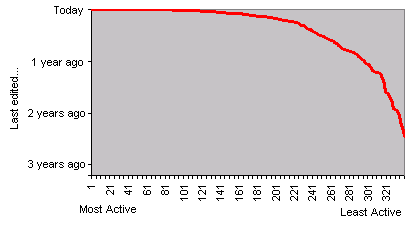
I wrote a little bot in java which harvested the information. I needed the date of their most recent wiki edit. Ranking the users by this metric, it turns out I was wrong. About half of these people have edited this month (pretty recently), and the vast majority have made edits within the last year. I guess people who go to the trouble of adding a ‘Living in London’ userbox, tend to be quite dedicated, and likely to stick around in the community.

Active London Wikipedians           

My plan was to send direct messages to the active users, to make sure they know about the next London Wikipedia Meetup. My original idea was to whittle down the list, to eliminate what I thought would be the large majority of inactive users. But this hasn’t helped me whittle down the list at all! It’s a more helpful ranking than an alphabetical list though:

London wikipedians ranked by most recent edit

Fun to play with developing bots too.

8th London Wikipedia Meetup

We went for a sunday lunch pub meet up with some wikipedia enthusiasts last Sunday. It took us a while to get this organised (and I even ended up doing a bit of the organising) but eventually the turn out was pretty good.

In the pub we had a few others like me, but actually most were wikipedia sysops and some were even more “powerful” within the chaotic organisation of wikipedia. I’m an enthusiastic wikipedia contributor, or at least I’m enthusiastic about what wikipedia represents. I am fascinated by wiki technology, and the processes that it facilitates within wikipedia (the most extreme example of a wiki).  I would say I have a deep understanding of this, but actually as far contributing goes, I only dip in and edit articles briefly when I spot somewhere I can make a quick improvement.

I met James F. who is on the wikipedia arbitration committee, and Theresa knott who used to be, and WJBscribe who is current chair of the mediation committee. What this basically means is, these people dedicate a lot of time and energy into keeping wikipedia going. These are the people who essentially have the “final say” with a calming voice of reason, when disputes turn nasty. I have a lot of admiration for them, but I wouldn’t want to take on the task myself.

What do I mean by “disputes”? Wikipedia encourages good will among contributors, as it opens up every article to public editing. Anyone can edit anything, and provided people act in good faith, that might be the end of the matter; the encyclopaedia just gets built… bit-by-bit, collaboratively. Remarkably this actually works a lot of the time. Unfortunately this is not always a harmonious collaboration. You may have to engage in a discussion to persuade others not to revert your edit. Where there is discussion, there may be debate, which leads to arguments, which lead to furious rows. Still, the people involved in such a row are allowed to edit the articles. To prevent the disputes raging out of control across the community, there are hierarchies and layers of permissions, and processes for “mediation” and ultimately “arbitration”. The people on the mediation and arbitration committee must regularly deal with people who will argue their cases politely (otherwise they would just be blocked), but who are simmering with anger and vitriol.

Seth Finkelstein’s critical description of wikipedia as an “elaborate hierarchical structure which is infested with cliques and factional conflicts” isn’t so inaccurate, but what does he expect? It’s an open community of volunteer editors in which the voices of sanity and calm need to somehow triumph when debates erupt. Perhaps he could suggest a better way of organising it (Instead he seems to be deeply concerned about the state of Jimmy Wales’ ex-girlfriend’s biography article). The mediation and arbitration committee have a kind of a position of power at the top of some hierarchy, but it looks like hard emotionally draining work. Clearly they are an essential part of what allows wikipedia to keep running smoothly. I am grateful that some people have the energy to do it.

Anyway… Those guys obviously enjoyed the opportunity to meet up face-to-face, chatting enthusiastically about organisational voting processes, and other such topics which went way over my head. The rest of us had some more down-to-earth chit-chat about general topics of interests. I briefly showed people some OpenStreetMap stuff before laptop battery died. This was all good fun. Hopefully we can arrange another London meet-up pretty soon.

Drive-by Contributions - The typo that never got fixed

I spotted a minor typing error in the Apache JMeter user manual. Most people wouldn’t worry too much about this, but I thought “This is a nice open project. I’d like to help out by fixing this typo”. I had thought that this might involve finding a file in a CVS repo and then submitting a patch, in which case… yeah maybe I won’t bother. The barrier is way too high. Too much hassle.

But to my delight I found that the manual was replicated (through some snazzy automated process no doubt) in a wiki. A simple search for the mispelling revealed it

“Great! Wikis are easy and openly editable! I’ll have this typo fixed in a jiffy”. Unfortunately not. Since web spammers moved in on the wiki scene its become increasingly difficult to keep wikis openly editable. It’s not impossible, but it involves deployment of a lot of anti-spam filters and careful stewardship. Most wiki administrators dont bother with that. Instead they raise the barrier by requiring registration and login to edit. This is very sad really. Due to spamming scumbags, these sites become less easy and accessible.

This typo fix is a classic example of the kind of “drive-by contribution” which you will miss out on if you require registration. For the vast majority of typing pedants, you’ve raised the barrier too high. There’s no way a normal person would bother to go through a registration process just to fix a typing error.

But I’m no normal person. I’m a wiki enthusiast. I’ve registered on hundreds of wikis just to change something minor. “If I don’t fix this typo nobody will”. So I head over the registration page and fill in the details, but what’s this? There’s a field which says “ASF = ?”. I dont know what it means, but I can feel the barrier raising. Is this typo really worth the hassle? I enter “what?” and submit.

The message “Incorrect expansion of acronym ASF” comes back. OK… so as I had actually suspected, this field is actually a kind of primitive captcha. A little puzzle which makes it more difficult for spammers to automatically register themselves on the wiki. It’s the next irritating line of defense, necessitated by particularly sneaky new breed of spammers who automate the registration process and keep coming back and spamming with new users every time they are blocked. In this case I am supposed to be filling in what ASF stands for. An automated spammer would struggle with this, but a human… well actually in this case a human would struggle with it too, so I think whoever set up this captcha maybe didn’t quite get the idea of it.

The barrier has raised higher. Not only do I need to register on the wiki, but I now need to know what ASF stands for (not to mention decoding the fact that this is what the field means) I’m thinking “This is getting silly. The typo is definately not worth it.”

“…ooh but what does ASF stand for? I’m actually quite curious now. Is this some basic knowledge that any human should have?”. I ponder it breifly but nothing comes to mind. In fact it ocurrs to me that there surely must be several different things that ASF stands for. “Which definition is it expecting? Probably the most widely known and accepted use of ASF, which according to google is… ‘Advanced Systems Format’. Never heard of it. Fine. Whatever. Paste it in…”

“Incorrect expansion of acronym ASF”

“&#*$*£&+ Fine! You know what! Screw your manual. You can keep your typo and I hope you choke on it!”